

What do candidates really want?

There’s very little accurate data on how people respond to recruitment advertising.
That’s mostly because how the data is collected is one-sided.
It’s often one-sided because all (or most) of the people surveyed are active candidates – and believe it or not, active candidates consume job advertising differently to passive candidates.
A passive candidate is someone who doesn’t need another job (because they’re employed) but might sometimes look at a job ad if it’s relevant and if they’re in the right mood.
These are the people who make up the vast majority of the target candidate audience for most jobs.
In the diagram at the top of this blog, the green part represents the passive candidates.
Window shoppers
If they’re capable of occasionally looking at a job posting when they don’t actually need another job, I’d describe them as ‘persuadable’. And many do, according to this report.
That’s usually because they’ve been in their current job 3-4 years and are starting to feel bored, unchallenged or underpaid. But it hasn’t got so bad that they’re desperate enough to read a long boring job description that, by definition, is only about the hiring company and what they want. They might skim read it at best.
You may remember that job posting heatmap that was doing the rounds a few years ago?
If you missed it, here it is again.
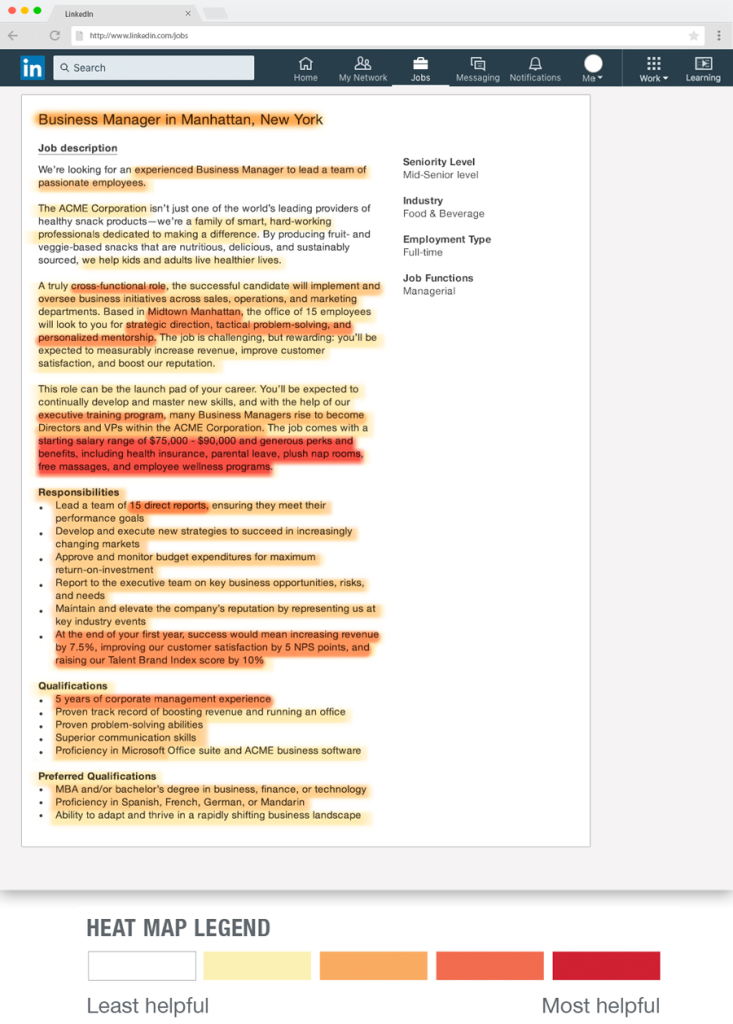
Where’s it hottest?
What this heatmap unequivocally illustrates is that when made to read a job posting, the parts people thought were most interesting were those that answered the question; “What’s in it for me?”
In this example, those parts are highlighted in red and orange.
I do a similar exercise in my 121 coaching with recruiters after they’ve done my training course. They write a new job ad, send it me and I “heatmap” it.
On at least 80% of the 600 or so job ads I’ve reviewed have lots of red and orange. That’s always a good sign because it tells me that recruiter has the right intent and has taken onboard the central essence of the training.
But the problem with many of them is that those red and orange parts are spread throughout the ad, rather than concentrated at the top. And the problem with putting the best parts in the middle and near the end is some of your target candidates won’t have read that far.
Why we’re not getting good data
In surveys about job postings, respondents who aren’t actively job hunting tend to answer the questions as if they were in “job search mode”.
They’re thinking about their job hunting experience in its entirety – and that entire experience is one of looking at job descriptions that are, by definition, only talking about the company and what the company wants. Their frame of reference is based on only seeing job postings that look and sound like job descriptions.
According to both LinkedIn’s survey (and my experience of training people how to write job adverts), the things your target candidates are most interested are, in order of importance:
1. Job title, salary and location. This is usually at the top of the job ad and this determines if someone is going to start reading it. For example, you’ll lose some people immediately if there’s no salary.
2. What’s in it for them. These are the reasons why your job might be better than the one they’re doing, or the others they’re applying for. Here’s a list of 39 things they might be.
3. Is it a job they can (or want to) do. The ad just needs to tell them the basic aims and tasks – the detail can come later. It needs to be just enough for them to broadly understand what they’d be doing. For example, a Sales Manager never needs to be told “they’ll be driving revenue”.
4. Do they have what the job is asking for. If they’re still reading, they’re interested – or at least curious. Next, they want to know if they’re potentially a fit. If they are, they’ll become even more interested.
5. Is it easy to respond. This is the CTA (call to action). What do they have to do to find out more? For most niche perm jobs, the more options they get, the more likely they are to do something.
Proof is in the pudding
Below is an example of 2 different job postings for a Tax Manager role in Florida.
I’ve called them Exhibit A and Exhibit B.
If every Tax Manager in Florida were shown both job postings and asked…
“Which one would you be most likely to read?”
“Which one would you most likely respond to?”
…which one do you think they’d choose? And by what ratio?