
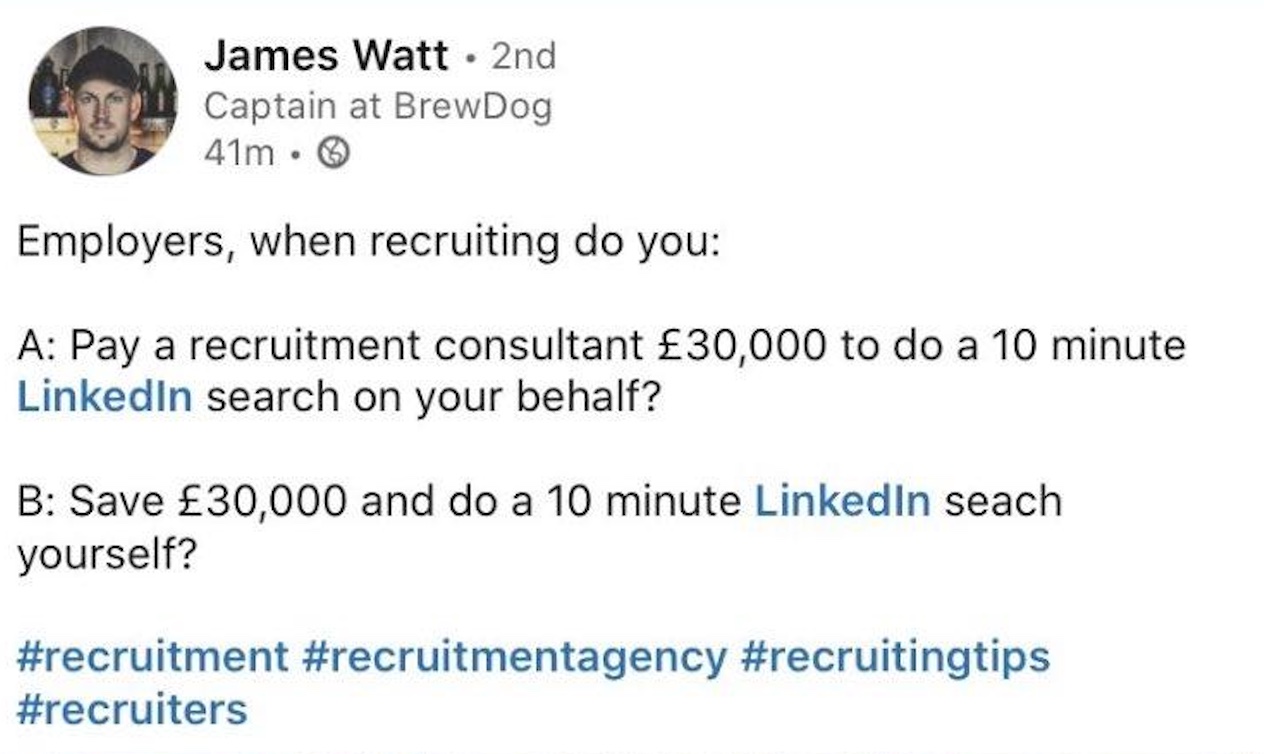
Captain BrewDog attacks the recruitment industry.

A few years ago, someone quite well-known posted the above comment on LinkedIn – and quickly removed it for some reason.
He also happens to work at a company that’s been hugely successful in recent years and recognised as having some interesting product marketing.
Recruiters didn’t like it.
If you didn’t see any of the fallout, take a look here, here and here.
Some seemed to take his post literally. That he really could find a candidate for a job paying somewhere between £100-150K in 10 minutes.
Or that having a quick look on LinkedIn, seeing a potential candidate with the right credentials, sending him/her an Inmail, getting a positive response back that includes their CV and then forwarding that CV onto the hiring manager, is pretty much all a recruiter does to earn a living.
Apart from sending out an invoice for 30 grand every time one of them lands. Which by the way, is fucking never.
Some other people got angry. Outraged even. They seemed indignant that someone relatively high profile was making disparaging remarks about their industry.
Lots of other people, me included, have taken the piss out of the recruitment sector before. But they didn’t become high-profile businesspeople, build a multi-million pound company, do some cool marketing and appear on the telly. As a case in point, I’ve only done one of those four things.
But all those other piss-takers didn’t matter.
They didn’t matter because they were just regular people who sometimes looked for other jobs or needed to fill jobs. The types of regular people who sometimes also get called hiring managers and candidates. Or in my case, an old recruiter.
For some, this outrage quickly fermented (sorry…) into a threat that they’d never buy BrewDog beer again. Would recruiters not drinking their beer make a dent in their £200M turnover? Knowing BrewDog, they’d probably start a new marketing campaign promoting the fact that recruiters had boycotted their brand. And it would probably work.
What’s really going on?
The problem with all this outrage, at least as I see it, is that it stops recruiters seeing the real issue.
What James Watt, the MD at BrewDog was really saying is that he thinks recruiters deliver little value. Or that if they do, it’s overpriced.
What he wasn’t saying was that recruiters regularly generate big fees as a result of doing 10 minutes work.
But whatever way you look at it, it’s about perceived value.
Recruitment agencies talk a lot about value, but very few can articulate what it looks like exactly – at least not in terms that mean anything to the client. I know because I’ve asked recruiters this question many times. It’s one of the reasons why all their websites look and sound the same. They all say they add value, but never say anything credible as to how.
A notional case study
Let me give you just one example.
Even better, let’s use James Watt at BrewDog to illustrate that example.
Let’s imagine that a potential candidate for a £100-150K job opening gets two InMails.
One from a director of a well-known company like BrewDog.
The other from a recruiter saying “We have an exciting job opportunity with a dynamic company that we think you’d be a good fit for”.
Which of those two messages do you think the potential candidate is going to take more seriously?
So, if we agree that James Watt sending job InMails to people is going to get many more positive response than Terry at Acme Appointments (who two years ago made a career transition towards recruitment and away from selling gym memberships) then we can start to see where his disdain for the industry might be coming from.
He’s saying that he too can use LinkedIn to find potential new employees and that he knows how to send InMails. Chances are he’s better at marketing than most recruiters as well, so his InMails are probably going to be more readable.
That is the difference in value perception. It’s a chasm.
Perception is reality
If this particular MD thinks recruitment agencies add very little, then there’s a pretty good chance that directors at lots of less well-known companies are going to think the same. It doesn’t matter if recruiters don’t think it’s true.
So, why do so many hiring companies see such little value in the agency service?
There are probably several reasons, but for me, one of them is that the recruitment agencies who do deliver good service, do nothing in their marketing to tell companies this. They all say the same thing in more or less the same way and it’s doing nothing to change people’s minds.
All they’re basically doing is telling people they fill a certain category of jobs. But what they’re not doing is telling them how they fill those jobs or why they fill jobs the way they do.
This is probably fundamental to why so many companies only see the value of recruitment agencies collectively, not individually.
Either way, I think both recruiters and hiring managers need to start understanding each other a little better. It shouldn’t be too hard, because they both want the same thing.
Recruiters need to understand that the only two things they need to be good at are Candidate Attraction and Candidate Assessment if they’re ever going to have happy clients who regularly come back for more.
Admittedly, they are two big things and will take some effort to get genuinely good at. But my point remains – if these two things are done reasonably well, jobs get filled without too many problems.
And that, fundamentally, is what all hiring companies want. They just want to know that they’re getting the right candidates because those candidates have been attracted and assessed well.
What’s your reality?
If you’re a recruiter, the quickest way to start educating potential clients to your true worth is through your job marketing. Because that’s where the rubber hits the road and is the easiest to measure.
It’s not that difficult to build a name for yourself by regularly putting out job ads that people want to read. At least then you’d be openly demonstrating that you’re good at something most hiring companies are bad at.
If both recruiters and hiring managers entered into more conversations armed with the same basic understanding of what needs to happen to fill a job, chances are a lot of the negative perceptions (and outcomes) could eventually be reversed.
By the way, the best time to have those conversations is when the hiring manager doesn’t have a live vacancy. That’s why it’s called ‘Business Development’. Apologies if that sounded sarcastic.
Then, when everyone has started talking to each other properly, maybe we can all stop doing stupid shit like boycotting a company’s products because an MD took the piss out of the industry we happen to work in.
So James Watt, the founder and MD of a very successful British beer company, posted on LinkedIn that recruiters don’t do much to earn their money.
The real outrage here is that he can say it, not that he did say it.
If you would like more thoughts and musings on recruitment, you might want to download Mitch’s free book “On Recruitment”.
Fancy a 20% discount on our standard copywriting for recruiters training course? Just use the coupon code outrage.